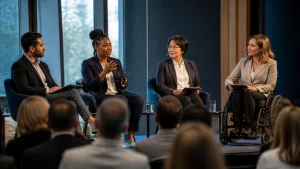
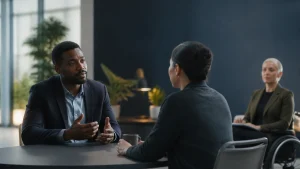
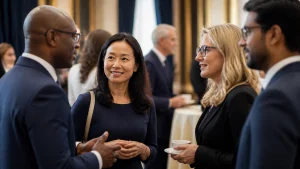
A panel discussion is not a series of individual speeches. It is a shared conversation that requires preparation, listening, concise communication, and respect for the audience, moderator, and other panelists. With the right preparation, emerging leaders and managers can contribute with clarity while allowing the full group to succeed.
Why panel participation requires a different kind of preparation
A presentation usually gives one speaker control over the message, pace, and structure. A panel does not. You must respond to questions, adjust to the direction of the conversation, share limited time, and remain engaged while someone else is speaking.
That makes panel participation a useful setting for practicing executive communication skills. You are demonstrating not only what you know, but also how you listen, collaborate, explain, disagree, and make room for others.
A strong panelist does not try to dominate every exchange. Instead, the panelist helps the audience understand the topic through focused contributions and thoughtful interaction.
Start with role clarity
Before preparing your answers, clarify the expectations for your role. Ask the moderator or organizer:
- What is the purpose of the panel?
- Who will be in the audience?
- What questions or themes are likely to be covered?
- How long will the panel last?
- How much time will each panelist have?
- Will there be opening remarks, audience questions, or closing comments?
- Will the panel be recorded, livestreamed, or photographed?
- What accessibility arrangements are available?
Also ask how your perspective fits with those of the other panelists. You may be participating as a manager, practitioner, subject-matter expert, community representative, or emerging leader. Each role calls for a different emphasis.
Role clarity prevents two common problems: repeating another panelist’s material and trying to answer questions outside your experience. If a question falls outside your knowledge, a direct response is more credible than speculation. You might say, “That is not an area I can address responsibly, but I can speak to the communication challenge involved.”
Prepare key messages, not a memorized script
Panelists need structure without sounding rehearsed. Prepare three central messages that you want the audience to remember. For each message, develop:
- A clear main point.
- One brief example.
- One practical implication for the audience.
For example, a manager speaking about workplace communication might prepare these messages:
- Clear expectations reduce avoidable confusion.
- Difficult conversations require preparation, not just confidence.
- Follow-up is part of communication, not an administrative afterthought.
You do not need a speech for each point. Instead, prepare short explanations and examples that can fit different questions. This approach gives you flexibility while keeping your contributions connected to the panel’s purpose.
Prepare a concise introduction as well. State your name, role, relevant experience, and connection to the topic. Avoid listing every credential. The audience needs enough context to understand your perspective, not a full professional biography.

Give concise answers that serve the audience
A useful panel answer is direct, understandable, and appropriately brief. Unless the moderator requests more detail, aim for a response that can be delivered in roughly 30 to 90 seconds.
A simple structure can help:
- Answer: State your main point first.
- Example: Offer a brief illustration.
- Application: Explain what the audience can do with the idea.
For example:
“The first step is to clarify the decision that needs to be made. In many teams, people leave a meeting with different assumptions because the decision was never stated plainly. Before ending the meeting, summarize what was decided, who owns the next step, and when follow-up is expected.”
This format respects time while still providing substance.
Avoid beginning with a long preamble or repeating the question at length. Use plain language instead of unexplained acronyms. If the audience includes people from different industries, levels of experience, or language backgrounds, define specialized terms and use concrete examples.
Concise answers also create space for other panelists. A panel becomes more useful when participants contribute distinct perspectives rather than competing for the longest response.
Build on other panelists’ points
Listening is part of your performance. While others speak, listen for ideas you can extend, clarify, or respectfully challenge. This creates a connected conversation instead of a series of unrelated mini-presentations.
Useful transitions include:
- “I agree with that point about preparation, and I would add one consideration.”
- “That example highlights an issue we often overlook.”
- “I see the situation somewhat differently, particularly when…”
- “Building on that, the practical next step may be…”
- “There is another perspective that may be useful for this audience.”
When you build on someone’s point, identify the idea rather than simply saying, “As she said.” This helps audience members follow the discussion and shows that you are responding thoughtfully.
Do not force agreement. Respectful disagreement can make a panel more useful when it is focused on ideas and supported by reasoning. Acknowledge the valid part of another perspective before explaining your own:
“I agree that speed matters in that situation. At the same time, moving quickly without clarifying responsibility can create a second problem. I would recommend a brief decision check before the team proceeds.”
Keep your voice even and your body language open. Avoid eye-rolling, dismissive gestures, interruptions, or expressions that make disagreement personal.

Practice time awareness and audience engagement
Panelists should know how much time they have and monitor their answers accordingly. Watch for signals from the moderator, such as a raised hand, a time card, or a transition to another speaker. If you are interrupted for time, stop cleanly and avoid trying to add several final points.
Audience engagement does not require constant humor or dramatic performance. It can be as simple as:
- Referring to the audience’s likely responsibilities.
- Using a short example that reflects a common workplace situation.
- Asking a question that invites reflection.
- Explaining how an idea might apply in a small organization and a large one.
- Acknowledging that participants may have different experiences.
When answering an audience question, listen fully before responding. If the question is unclear, ask for clarification. You can also paraphrase it briefly:
“If I understand correctly, you are asking how a manager can address the issue without embarrassing the employee.”
Then answer the question asked, not the question you hoped to receive. If the issue is too broad, provide one practical starting point and note what would require further discussion.

Make the panel accessible and inclusive
Accessibility should be part of planning, not an afterthought. Organizers and panelists should consider the physical room, virtual platform, materials, sound, lighting, and pace of the discussion.
Depending on the setting, useful practices may include:
- Confirming step-free access and clear pathways to the stage or seating area.
- Using microphones consistently, including for audience questions.
- Speaking at a measured pace and avoiding unnecessary background noise.
- Describing important visual information when slides or demonstrations are used.
- Providing captions or live transcription when appropriate.
- Sharing materials in accessible formats.
- Avoiding color-only instructions in presentation materials.
- Explaining acronyms and industry terms.
- Allowing enough time for interpretation, captioning, or other communication support.
- Asking participants what accommodations would help them engage.
Accessibility also includes sensory and communication considerations. Some people may process information more easily when answers are clearly structured. Others may need a moment before responding. A calm pace and organized language benefit the entire audience.
Cultural awareness matters as well. Expectations about eye contact, interruption, titles, humor, and directness vary among individuals and communities. Do not assume that one communication style is universally preferred. Focus on clarity, respect, and the needs of the specific audience. When a panel includes international or cross-cultural participation, confirm expectations with the host or organizer.
Follow up after the panel
Your contribution does not end when the moderator closes the discussion. Take a few minutes to review what you learned:
- Which answer felt clear and useful?
- Where did you speak too long?
- Did you leave enough room for other panelists?
- Which audience questions deserve a written resource or further conversation?
- Did you accurately represent your experience?
- What would you prepare differently next time?
If appropriate, send the moderator a brief thank-you note. You may also share a resource that directly answers a question raised during the panel. Do not use follow-up as an excuse for unsolicited promotion. The purpose is to be helpful and maintain a professional connection.
For managers, a panel can also become a team learning exercise. Invite colleagues to discuss how the panel was structured, which answers were most accessible, and how the speakers handled disagreement. This turns a one-time speaking opportunity into practical development.
A practical pre-panel checklist
Before the event, confirm that you have:
- Clarified your role, audience, format, and time limit.
- Prepared three key messages and brief examples.
- Practiced a concise introduction and closing comment.
- Reviewed the moderator’s questions and the other panelists’ perspectives.
- Prepared language for building agreement and expressing disagreement.
- Tested the microphone, camera, lighting, or presentation materials.
- Identified accessibility needs and confirmed available accommodations.
- Practiced answering without relying on a script.
- Planned how you will follow up after the discussion.
Public speaking coaching can help you refine voice, pace, posture, eye contact, and answer structure. More broadly, professional development workshops can give emerging leaders and managers a structured setting to practice these skills, receive feedback, and apply them to panels, meetings, forums, and presentations.
Strengthen your panel and presentation skills with TCG
The Comportment Group provides public speaking and presentation skills training for professionals, executives, civic leaders, and client-facing teams. TCG’s work includes message organization, audience engagement, voice and delivery, body language, preparation, and practice for panels and other high-visibility settings.
Explore The Comportment Group’s course catalog to review public speaking, executive presence, workplace professionalism, and related training options.