Technical proficiency is no longer the primary differentiator of a leader. In the professional landscape of 2026, the hard skills that once secured a promotion now serve only as the baseline for entry. The real competitive advantage lies in the behavioral. It lies in the relational. It lies in the human. As organizations integrate more sophisticated technology and automation, the demand for high-level soft skills training for employees has reached a critical inflection point. Leaders are no longer judged solely by the data they produce. They are judged by the environments they create and the trust they inspire.
The Comportment Group understands this shift with precision. We have built a curriculum of over 50 courses designed to bridge the gap between technical ability and professional presence. Presence is not an accident. It is a deliberate application of behavioral standards. In 2026, leadership requires a new level of polish and emotional intelligence. The room reads the leader before the leader speaks. If the leader lacks the tools of comportment, the message is lost. Soft skills training is the mechanism that ensures the message is heard.
The evolution of leadership in a digital era
The definition of leadership has undergone a fundamental transformation. Years ago, a leader was a subject matter expert who directed tasks. Today, a leader is a facilitator of culture and a guardian of reputation. The rise of artificial intelligence has automated the routine. It has streamlined the technical. What remains is the uniquely human element. This is why soft skills training for employees is the most significant investment an organization can make this year.
In 2026, leadership is about managing complexity through connection. It involves navigating hybrid environments where digital signals are just as important as physical ones. It requires a mastery of corporate communication training that transcends traditional boundaries. A leader must be as effective over a video conference as they are in a boardroom. They must understand that every interaction is a signal of their authority and their competence.
Why soft skills training for employees is critical now
Retention is the new growth. Organizations that fail to develop their people lose their people. Employees in 2026 do not just leave jobs. They leave cultures that feel cold, disconnected, or unprofessional. When a company invests in professional development workshops, it sends a message of value. It tells the employee that their presence matters. It tells the team that standards exist.
Consider the following reasons why behavioral training is essential:
- High-trust environments move faster.
- Professionalism reduces friction in collaboration.
- Clear communication prevents costly errors.
- Composed leaders stabilize teams during volatility.
- Polished teams win higher-value clients.
The stakes are higher than ever. A single professional misstep can ripple through social media and damage a brand in minutes. A leader who lacks discretion or composure is a liability. Soft skills training provides the armor of professional standards. It ensures that every member of the team represents the organization with dignity and precision.

Common mistakes in leadership development
Many organizations approach training as a checkbox exercise. They schedule a generic seminar and expect immediate transformation. This is a tactical error. Behavioral change requires rigor. It requires repetition. It requires a connection to real-world outcomes.
One common mistake is prioritizing technical upskilling at the expense of workplace professionalism training. A brilliant engineer who cannot lead a meeting effectively is stalled. A sales executive who lacks dining etiquette will lose the contract at the dinner table. These are not small details. These are the details that decide the future of the firm.
Another error is the neglect of entry level professional skills. Organizations often assume that new hires arrive with a full understanding of office protocol. This is rarely the case. Many emerging leaders have never been taught how to navigate a formal introduction. They have not been coached on email etiquette or the nuances of professional attire. When a company fails to provide this foundation, they set their talent up for failure.
The power of professional image and presence
The way a leader carries themselves is their first act of communication. This is why professional image consulting is a core component of modern leadership. Presence is about more than clothing. It is about the alignment of appearance, behavior, and communication. In 2026, the visual signal must match the verbal message.
A leader who appears disheveled or indifferent projects a lack of discipline. A leader who is overly casual in a high-stakes environment projects a lack of judgment. Professional polish is a form of respect for the client and the mission. It signals that the leader is prepared for the responsibility they hold. The Comportment Group teaches leaders how to curate this image with intentionality. We move beyond the surface to the core of executive presence.
Mastery of business etiquette and protocol
Etiquette is often misunderstood as a set of restrictive rules. In reality, it is a tool for ease. It is a system that removes social anxiety so that business can happen. When every person in the room knows the rules of engagement, focus remains on the objective. This is why business etiquette courses are surging in popularity among high-performing teams.
In 2026, protocol matters more because our environments are more diverse. We work across cultures, generations, and geographies. A universal standard of respect is the bridge that connects these differences.
- Introductions must be handled with confidence.
- Dining must be navigated with grace.
- Digital interactions must maintain professional boundaries.
- Conflict must be managed with poise.
When these skills are absent, the organization appears amateur. When they are present, the organization appears elite. Elite teams do not guess. They know the standards.

Practical standards for the 2026 leader
To lead effectively in the coming years, a professional must master several core competencies. These are not suggestions. These are requirements for high-stakes leadership.
- Adaptive communication. A leader must adjust their tone and medium to the audience. They must know when an email is sufficient and when a face-to-face conversation is necessary. Clarity is the goal. Brevity is the method.
- Emotional composure. The ability to remain calm under pressure is the ultimate leadership signal. Anxiety is contagious. So is composure. A leader who masters their reactions masters the room.
- Inclusive professionalism. Respect is the baseline. A leader must ensure that every voice is heard and every person is treated with dignity. This is not about politics. This is about performance.
- Reliability and follow-through. In a world of distraction, the person who does what they say they will do is rare. Professionalism is built on the foundation of trust. Trust is built on the foundation of consistency.
The Comportment Group provides the framework for these standards. We teach the granular behaviors that lead to these outcomes. We do not just discuss concepts. We train actions.
Examples of the standard in action
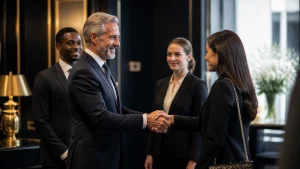
Imagine a scenario where a firm is pitching a multi-million dollar contract to a global client. Two teams are equally qualified technically. Team A arrives on time. They are dressed in custom-fitted, professional attire. They greet the client by name with a firm handshake and direct eye contact. During the meal, they navigate the table with ease. They listen more than they speak. They handle a difficult question with calm and clarity.
Team B is five minutes late. They are dressed casually for a formal meeting. They are distracted by their phones. They dominate the conversation and speak over one another. They appear uncomfortable during the formal dinner.
The client will choose Team A every time. The choice is not based on the data in the slides. The choice is based on the confidence the team inspires. The client is not just buying a service. They are buying a relationship. They are buying the peace of mind that comes with professional excellence.
How training transforms organizations
Soft skills training for employees changes the internal chemistry of a company. It raises the floor of acceptable behavior. When everyone is trained in the same standards, the culture becomes self-correcting. Peer-to-peer respect increases. Friction decreases. Leadership becomes more effective because the path is clear.
Organizations that invest in these workshops see measurable results. According to research from the World Economic Forum, the most valuable skills for the future are those that machines cannot replicate. Empathy, social influence, and complex problem solving are at the top of the list. These are the skills we teach at The Comportment Group. We prepare your people for the rooms they are expected to enter.
Why The Comportment Group fits the need
We are not a generic training firm. We are specialists in polish, presence, and professional behavior. Our founder, Mack McFadden, believes that comportment is a skill that can be learned, practiced, and mastered. We bring a refined, practical, and human approach to every session.
We serve law firms, accounting firms, wealth management groups, and universities. We help founders find their voice. We help students find their confidence. We help teams find their edge. Our 50-course library covers the full spectrum of professional life. Whether you need executive presence coaching or entry level professional skills training, we have the curriculum.
We do not offer fluff. We offer standards. We do not offer hype. We offer results. Our training is designed for those who understand that the details are not the details. The details are the brand.

Conclusion
The future of leadership is behavioral. As we move into 2026, the technical will become even more accessible, making the personal even more valuable. Soft skills training for employees is the bridge to that future. It is the investment that pays dividends in trust, reputation, and revenue.
Do not leave your professional image to chance. Do not assume your team knows the unwritten rules of the room. Give them the tools to move with confidence. Give them the polish to represent your organization with honor.
Presence, precision, and dignity are skills. They can be taught. They must be practiced. The Comportment Group is ready to lead the way.
The Comportment Group
Carry yourself like the room is yours.
Presence, precision, and dignity are skills, not accidents. Our 50-course library teaches the unwritten rules of professional life so you and your people can walk into any room and own it. Let's talk about where to begin.
Explore the curriculum → | Book a pilot cohort
Phone: (510) 603-0909 | Email: info@thecomportmentgroup.com | Web: www.thecomportmentgroup.com
Presence. Precision. Dignity in the details.
Disclaimer
The content published on this blog by The Comportment Group, a venture of The McFadden Finch Holdings Company, is provided for general informational and educational purposes only. It reflects the views and professional perspective of the author at the time of writing.
Nothing in this article constitutes professional, legal, financial, career, or psychological advice, and it should not be relied upon as a substitute for guidance from a qualified professional who knows the specifics of your situation. Reading this content does not create a client, advisory, or consulting relationship with The Comportment Group or McFadden-Finch Holdings.
We make no warranty as to the accuracy, completeness, or current applicability of the information presented. Professional standards, workplace norms, and best practices evolve, and outcomes vary by individual and context. Any action you take based on this content is your own responsibility.
All content, including text, course concepts, frameworks, and the marks "The Comportment Group" and "Presence. Precision. Dignity in the details," is the property of The McFadden Finch Holdings Company and may not be reproduced, distributed, or used without written permission.
© 2026 The Comportment Group, a venture of The McFadden Finch Holdings Company. All rights reserved.
FAQ
What is the return on investment for soft skills training?
Soft skills training for employees directly impacts the bottom line by reducing turnover and increasing team efficiency. When leaders communicate with clarity and composure, project delays and misunderstandings decrease. Furthermore, a polished professional image and mastery of business etiquette are often the deciding factors in winning high-value contracts. Organizations that prioritize these behavioral standards report higher employee engagement and a stronger market reputation.
How does corporate communication training help remote teams?
Remote and hybrid work environments rely entirely on digital signals. Without the benefit of physical presence, every email, chat message, and video call carries more weight. Corporate communication training teaches leaders how to project authority and empathy through a screen. It focuses on clarity, tone, and the selection of the appropriate medium for the message. This ensures that the team remains connected and aligned, regardless of their physical location.
Why is professional image consulting relevant in 2026?
Professional image is a visual shorthand for competence and respect. Even in a more casual world, the way a leader presents themselves signals their attention to detail and their understanding of context. Professional image consulting helps individuals align their outward appearance with their internal goals. It provides the confidence needed to navigate diverse professional settings, from creative studios to corporate boardrooms, with authenticity and authority.
Can business etiquette be taught to experienced executives?
Yes. Professional standards are not static. As global business norms evolve, even the most seasoned executives benefit from a refinement of their protocol skills. Business etiquette courses provide a safe environment to update skills in areas like international protocol, digital boundaries, and sophisticated dining. This training ensures that a leader's social grace matches their professional experience, allowing them to move through any setting with ease.
Who should participate in workplace professionalism training?
Professionalism training is valuable at every level of an organization. For entry-level employees, it provides the "unwritten rules" that are often missed in traditional education. For mid-level managers, it builds the influence and relationship-management skills needed for promotion. For executives, it focuses on high-level presence and reputation management. A unified standard of professionalism across the entire organization creates a cohesive and elite brand identity.